January First
Michael Schofield
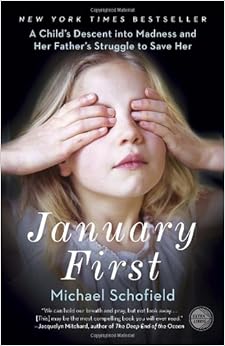 In this memoir, author and narrator, Michael Schofield, gives us a view on the life of dealing with a schizophrenic daughter, January, better known as Janni. Janni is very violent, because the hallucinations inside of her head tell her to hit people, like her baby brother, Bodhi, or her golden retriever. She has difficulty staying concentrated and getting along with other children, and it is a constant struggle for Michael and Susan to keep her out of trouble, and take care of Bodhi at the same time. Throughout the whole story however, you can see that Michael never gives up on Janni, even when he doesn't know that she has schizophrenia yet. He believes that she is a special, unique child, and he never fails to make her feel better, when no one else will play with her.
To learn more about this book, click here!
He loves her unconditionally. That type of love, I believe, is something special reserved only for parents. They watch you grow up, learn, and make mistakes, yet nothing you do could ever stop them from loving you.
According to Dictionary.com, unconditional love is:
"affection with no limits or conditions; complete love."
This couldn't be more true, and this book is a perfect example of that phrase. Even before discovering that Janni had schizophrenia, when he thought that she just had imaginary friends (instead of hallucinations), he never gave up on her. When she told others about her imaginary friends, they would blow it off like she was a little kid, and she would get upset. Michael, however, played along with her. He would pretend to fix the broken leg of 400, the imaginary cat, even if it meant looking ridiculous, working over a patch of grass. He does the best for her at all times, even if it meant hurting himself in the process.
"Every instinct in my body tells me to get up and take Janni home. But if I do, nothing will change. I've tried to save Janni all her life and I can't. I'm not enough. She needs more."Call the cops," I say quietly." (Schofield, 210)
In this quote from the book, Michael realizes there is nothing more that he can do to help his daughter. And even though it kills him to do so, he lets the cops take her, so that she can finally get the help that she needs.
However, in no way is unconditional love limited to just blood relations. In Milwaukee, Wisconsin, Denise and John Potter are the parents of five foster children. Though one of their children were shot and killed by two black men, it didn't affect the way they looked at people's skin color. They adopted another child soon after, believing that skin color had no affect on their love for the child.
"Our son, Nathan, was killed by two black young men, and it would be easy to become racist because of that one incident. When you bring home this child that is the same skin color, and you look at this gift from God that you are holding, you realize this is not something about color, and so in one small way, if we can affect one small child in the name of our son, that's one positive thing we can add." (John Potter)
To learn more about Denise and John's story, click here!
