Thursday, March 12, 2015

3/12/15

Fahrenheit 451 Theme Handout

Theme statement: Individual Self-Expression Is Important
Group Members: Marina Walters, Rebecca Shu, MacKenzie Miller, Grannt Epstein, and Anthony Lev
Bell 4

Three specific textual examples from the book that show how this theme is developing:      
  1. “‘ It doesn’t think anything we don’t want it to think.’”
Bradbury, Ray. "The Hearth and the Salamander." Fahrenheit 451. New York: Del Rey Book, 1991. 27. Print.
2. "‘ Nobody listens anymore. I can’t talk to the walls because they’re yelling at me. I can’t talk to my wife; she listens to the walls. I just want someone to hear what I have to say. And maybe if I talk long enough, it’ll make sense. ‘“ (pg. 82)
Bradbury, Ray. "The Sieve and the Sand." Fahrenheit 451. New York: Del Rey Book, 1991.
82. Print.
3. “...and if the men were silent it was because there was everything to think about and much to remember. Perhaps later… when the sun was up and had warmed them, they would begin to talk, or just say the things they remember...’” (pg.164-165)
Bradbury, Ray. "Burning Bright." Fahrenheit 451. New York: Del Rey Book, 1991. 164-65. Print.

Timeline of Theme
Part 1:

  • Montag, in the beginning showed his patch to others to show that he was a fireman. (Firemen were those at the time lit fires instead of extinguish fires) The salamander was had thought to have lived in fire and wasn't affected by it. This was also given to the name of the firetrucks to “show the flame.”

  • A woman in the book burnt herself with her books to symbolize that she would rather die than let firemen burn them. It states, “The woman's hand twitched on the single matchstick. The fumes of kerosene bloomed up about her.” (Page 49) Guy also shows his curiosity (his true self) by stealing a book and hiding it in his coat to read later.

 Part 2:
  • Towards the middle of the book Montag had started to be more open with his thoughts about the burning of books. He was standing up for them and putting himself out there to try to save the books to show the society how important they really are. He believes that if he starts to show his feelings for the books then he could possibly make a change in making a more perfect society.

Part 3:
  • Into the end of the book the people will now begin communicating with each other instead of keeping to themselves by doing this is demonstrating them expressing themselves through collaboration and communication which was not heard of before. One example of this would be when Clarisse says that they actually use their family room for spending time together and communicating which shocks everyone. By the end of the book though seeing this communication and the people enjoying themselves demonstrates the importance of self expression. This can be seen on page 164-165.


Individual self expression allows Montag to make changes to the world and create a different way of thinking for the people in the city, by the end of the book people are memorizing whole books about self expression without the self expression nothing would have changed.

Individual self-expression can be seen in our modern-day society when we look at the tv show “Modern Family” when individual characters such as how Cam chooses to express himself by trying to go back into teaching again, this is important to the theme by showing it in a modern contexts.

Sunday, March 8, 2015

3/8/15

Fahrenheit 451: Technology 


In this article, authors discuss how technology, mainly video games, are a good influence on many kids, instead of the popular belief that they are bad for children. 

Technology used for entertainment isn't always bad for children. Studies have shown that video games can actually help kids learn and enhance their abilities. Video games aren't only harmful, but can help children in many different areas of their life.

Video games can help improve people's moods. Studies show that, "Simple games that are easy to access and can be played quickly, such as "Angry Birds," can improve players' moods, promote relaxation and ward off anxiety." This may help people who are feeling stressed or depressed to feel happier, and can cause their actions to be friendlier. As a result of this, people could end up working harder, and new ideas and advancements in technology could be developed. Video games could also help improve children's problem-solving skills. Studies also show that, "The more adolescents reported playing strategic video games... the more they improved in problem solving and school grades the following year." Playing these types of video games could actually help children's performances in school, instead of hurting them. They could also help to develop important problem solving skills that can help them later in life. 

Some people may say that playing too many video games causes one to become anti-social, or to not have any friends. However, "More than 70 percent of gamers play with a friend and millions of people worldwide participate in massive virtual worlds through video games such as "Farmville" and "World of Warcraft"..." Through multiplayer games, players are able to make friends online, and learn to cooperate with others through interactive games. This can prevent social awkwardness, which may result from people who don't have any opportunities to interact with others. 

Video games aren't necessarily a bad influence on children. They can help improve people's moods, problem solving skills, as well as social skills. Video games aren't only harmful, but can help children in many different areas of their life. 

Thursday, January 15, 2015

1/15/15
Hush, Hush
Becca Fitzpatrick


Hush, Hush is a hardcore fantasy, mainly directed towards people who like to fangirl over things. In my opinion, it is a mix between Twilight and Maximum Ride.

The main characters name is Nora, and she is just an average sophomore living in Maine. But, of course, like all girly books, there is something so special about this average girl that she immediately draws the attention of Patch Cipriano, an older boy in her class who has failed biology many times. She is immediately drawn to him (like Bella) and can't stop thinking about him.


"Coincidentally", their separate groups of friends run into each other at the local fair, and she somehow "ends up" next to Patch just as they are about to ride the Archangel, a giant roller coaster. That's when things start getting suspicious. She has, almost an out-of-body experience, where she feels like she's falling off the roller coaster, only to end up back in the seat next to Patch.
After being "abandoned" by both of their friends, Nora is forced to let Patch drive her home. She invites him in, and he immediately starts to make tacos. Yes. Tacos. She becomes scared as she sees the knife in his hand grow in size, but immediately dismisses it as her mind playing tricks on her.

Many other strange events occur, but she keeps coming up with explanations as to why they are happening.

As her and Patch grow closer, he reveals to her that Jules, her best friend, is actually another fallen angel who wants revenge on Patch.

Stuff happens, blah blah blah, and somehow, when Nora accidentally touches the scars on Patch's back, he ends up explaining everything to her.

Apparently, Patch is actually a fallen angel from heaven who was trying to kill her, in order to have a real human body, which pretty much explains all of the strange things that have been happening to her. She becomes afraid, but, like always, he claims that he's fallen in love with her (-_-), and that he will never hurt her. Many other people, who either are in love with Patch or hate him, try to kill Nora but obviously, he saves her every time.

Eventually, it is revealed that Jules is actually the bad guy, and he tries to kill Nora. Patch (obviously), comes to the rescue and the two have a whole manly showdown, resulting in Patch coming out victorious and Jules dying.

The two kiss and make up, and they live happily ever after. Just kidding. There are three other books to the series, so be warned.

Overall, I thought the  book was pretty good, though cheesy and cliche, and having many plot similarities to Twilight. However, the book was very well written, and the author really builds the suspense up nicely. It was an interesting book, so if your bored and looking for a good fantasy book, be sure to check it out.

Click here to read the full summary!!!!!

Wednesday, January 14, 2015

11/20/14
Sixth Grade Secrets
Louis Sachar

Yes, I am a freshman reading a book about sixth graders. Deal with it.

Sixth Grade Secrets has many different plot lines. However, the main problem revolves about Laura and her club, Pig City, facing off with her enemy, Gabriel's club, Monkey Town. Yes. Those are, the real names of their clubs. Remember, they are only sixth graders.
Pig City is a secret club (since clubs are banned at their school) started by Laura and her friends, based on the words written on the hat that she bought from a garage sale. After initially inviting Gabriel to join her club, they meet up, but immediately don't get along. After angrily leaving her house, he decides to form his own club, inviting all the people that Laura hates. The two clubs go to war (prank wars), lives are lost (shirts are ruined), and lines are crossed (someone gets an illegal haircut).
However, like all sixth grade problems, they eventually come to an end, after about a month.

Dynamic Character- Laura
Laura has extremely long hair, due to the fact that when she was very young, her father promised to let her not cut her hair, if she never lied. And she never did (which is pretty ridiculous, if you ask me). However, towards the end of the book, she realizes that she was only telling half truths most of the time, which, in her case, still counted as lies.
At the beginning, Laura is very rebellious, forming a secret club, and opinionated towards other people. She forces others to give her "insurance", something embarrassing for her to keep in a box, in order to join the club, so that if they ever betray her, she will expose that embarrassing thing to the world. Personally, I think that she is being very selfish and immature about the whole club thing, but I guess she thinks she's being cool.
Her secret is that she is in love with her teacher, Mr. Doyle. This quickly changes after he punishes her for pulling pranks that he had no proof that she pulled (even though she did). This change is also due to the fact that she falls for someone else, someone else her own age, a boy whose name starts with a G... hint hint.


I honestly first read this book when I was in fifth grade, but when you really like a book, it never gets old. As I got older, I realized I had different thoughts towards the book. For example, when I first read it as a fifth grader, I thought it was the coolest book ever, and even wanted to start my own secret club. Now, however, as an older freshman, I can't help but think how stupid their problems are, or how everyone seems to blow everything way out of proportion. I find it quite childish and hilarious when reading it now, but even as a high-schooler, I can't help but think that their sixth grade secrets are nothing like what I have to deal with today. 

Tuesday, November 4, 2014

11/4/14
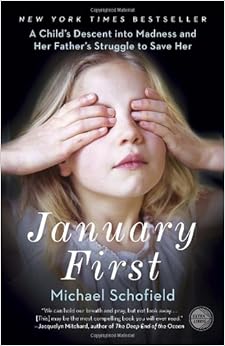
January First
Michael Schofield


In this memoir, author and narrator, Michael Schofield, gives us a view on the life of dealing with a schizophrenic daughter, January, better known as Janni. Janni is very violent, because the hallucinations inside of her head tell her to hit people, like her baby brother, Bodhi, or her golden retriever. She has difficulty staying concentrated and getting along with other children, and it is a constant struggle for Michael and Susan to keep her out of trouble, and take care of Bodhi at the same time. Throughout the whole story however, you can see that Michael never gives up on Janni, even when he doesn't know that she has schizophrenia yet. He believes that she is a special, unique child, and he never fails to make her feel better, when no one else will play with her.

To learn more about this book, click here!

He loves her unconditionally. That type of love, I believe, is something special reserved only for parents. They watch you grow up, learn, and make mistakes, yet nothing you do could ever stop them from loving you.

According to Dictionary.com, unconditional love is:
"affection with no limits or conditions; complete love."


This couldn't be more true, and this book is a perfect example of that phrase. Even before discovering that Janni had schizophrenia, when he thought that she just had imaginary friends (instead of hallucinations), he never gave up on her. When she told others about her imaginary friends, they would blow it off like she was a little kid, and she would get upset. Michael, however, played along with her. He would pretend to fix the broken leg of 400, the imaginary cat, even if it meant looking ridiculous, working over a patch of grass. He does the best for her at all times, even if it meant hurting himself in the process.

"Every instinct in my body tells me to get up and take Janni home. But if I do, nothing will change. I've tried to save Janni all her life and I can't. I'm not enough. She needs more."Call the cops," I say quietly." (Schofield, 210)

In this quote from the book, Michael realizes there is nothing more that he can do to help his daughter. And even though it kills him to do so, he lets the cops take her, so that she can finally get the help that she needs.

However, in no way is unconditional love limited to just blood relations. In Milwaukee, Wisconsin, Denise and John Potter are the parents of five foster children. Though one of their children were shot and killed by two black men, it didn't affect the way they looked at people's skin color. They adopted another child soon after, believing that skin color had no affect on their love for the child.

"Our son, Nathan, was killed by two black young men, and it would be easy to become racist because of that one incident. When you bring home this child that is the same skin color, and you look at this gift from God that you are holding, you realize this is not something about color, and so in one small way, if we can affect one small child in the name of our son, that's one positive thing we can add." (John Potter)

To learn more about Denise and John's story, click here!


Thursday, October 16, 2014

10/16/14

Delirium
Lauren Oliver

Prompt:  Are any characters in your book comparable to characters you’ve seen in other books, television shows, or movies?  Can you compare any characters to someone you know in real life?

The main character in this story Lena, lives in a perfect world, where everyone has a place, a job, a family. But this world is one where one thing is forbidden. LOVE :O

The government believes that love destroys people; it only makes them weak and vulnerable. And Lena has seen it in her own mother. After her husband died, she had gone slightly crazy, and had eventually thrown herself off a cliff. The government had invented a procedure, given to every citizen on their eighteenth birthday, that would get rid of the horrible disease, "love", forever. Lena can't wait to get the cure; she believes that it will save her.

However, a few months before her eighteenth birthday, she - you guessed it- falls in love. -_- He is a boy named Alex, and he is rebel. Someone who she would never associate with, someone who broke the rules, who defied the government. She was a goody two shoes, but I guess that's what love does to you..?

She begins to step out of the boundaries of her city, a place forbidden by the government, and there, she discovers a whole new world. There is a rebellion happening, and she has just joined it. 

Lena reminds me of every other generic, female hero- defiant, overconfident,  head strong. In other words, she constantly gets herself in trouble because she does things without ever thinking of the consequences first. That leads to her constantly putting herself in danger, and leaves it to some male figure to come and rescue her. How clique. 

Some examples of other female characters like this (in my opinion) would be :
Tris-Divergent
Cassia-Matched
America-The Selection
Bella-Twilight
Clary-The Mortal Instruments
Nora-Hush, Hush
Lucy-Fallen
Max-The Angel Experiment

Though I feel as if Lena isn't the smartest, and the plot of the book is very clique, I do think it has nice quotes that make you think deeper into the problems of life.

“Love: a single word, a wispy thing, a word no bigger or longer than an edge. That's what it is: an edge; a razor. It draws up through the center of your life, cutting everything in two. Before and after. The rest of the world falls away on either side.”

“Hate isn’t the most dangerous thing, he’d said. Indifference is.”

“I know that life isn't life if you just float through it. I know that the whole point- the only point- is to find the things that matter and hold onto them and fight for them and refuse to let them go.”

I would recommend this book to those who like having a strong female lead, a sappy love story, and thoughtful quotes. :)

Wednesday, October 15, 2014

10/15/14

Freeze Tag
Caroline B. Clooney

In this creepy, cold book, freeze tag isn't just a game. It's reality. :O

Meghan has the perfect life; a loving family, a perfect boyfriend, popularity. But there's one problem. Lannie. They've been childhood "friends" since she first moved into the neighborhood, but Lannie was always different. She had cold, piercing eyes, with an eternal far away look in them. And there was one more thing. She could freeze anyone, anytime, with just a touch of a finger. 

         "Even Lannie's words could freeze. Tuesday's leaping lungs and throbbing hear went to slow   motion, and her skipping mind fell. No. Recue teams cannot save them. Our mother and father cannot save them. That terrible little phrase 'froze to death' hung in front of all Tuesday's thoughts like an icicle hanging off a porch." (Clooney, 83)

There was nothing more that Lannie wanted than Meghan's boyfriend, West. She would do anything to have him for his own- even risking Meghan's life. She froze Meghan, and made West promise to love her best, forever. Fearing for her life, West agreed. Worst mistake of his life.

As they grew older, and Meghan and West began to plan the rest of their lives together, Lannie comes in, reminding them of the promise he made to her, all those years ago. West leaves Meghan, to protect her, but promises to keep meeting her in secret. 

But, he begins to change. Slowly, he begins to forget to meet her, to stop sitting with her at lunch, to stop inviting her over for dinner. And she notices that he, has become like Lannie. Cold, uncaring, unloving. But she still wants him.

His siblings, Tuesday and Brown, also hated Lannie. The two had devised a plan to get rid of Lannie forever, by giving her a taste of her own medicine. They would lock her in a car, in the middle ot a blizzard, so that she would freeze to death.

But as Meghan discovers this plan, she realizes what people they have all become. Though they never were frozen by Lannie, their thoughts were still cold, and all that was in their eyes, was coldness. So she walked out alone, into the stormy blizzard, and unlocked the door. 
          
         " This is what it means, thought Meghan Moore, to choose the lesser of two evils. Lannie is evil, but it would be more evil to stand aside and silently let her die..... 
                       "Come in my house where it's warm," said Meghan.
                         Lannie said nothing.
                         Perhaps she was too cold to speak.
                         Or perhaps..she had waited all her life to come in where it was warm." (Clooney, 166)

Though this book was short, I will never forget the haunting creativity the author had, or the vague message it sent. The ending line, as seen in the quote above, allows the reader to use their imagination, in the somewhat happy ending. 

I would recommend this book to anyone who likes creepy things, or to someone who is in search for something a little different.